







The industry spent years building better bot detection. Attackers noticed. Then they adapted.
Human fraud farms emerged as a direct response to that investment. Where bots leave machine-like signatures that behavioral analytics can catch, human workers leave human signatures: natural mouse movements, realistic typing cadence, genuine dwell time, real device hardware. The result is a threat that blends seamlessly into legitimate traffic and defeats the fundamental assumption underpinning most modern fraud defenses; that suspicious sessions are generated by machines.
That was already a hard problem. It just got harder.
How Human Fraud Farms Are Organized
A human fraud farm is an organized, often professionally managed criminal operation. Workers are recruited, typically through social media, job boards, or messaging apps, frequently under the pretense of legitimate data entry or remote work, and paid to complete repetitive fraudulent tasks at scale. Coordinators distribute targets, scripts, and step-by-step instructions. Workers execute.
A single operation can deploy dozens to hundreds of workers simultaneously, executing thousands of fraudulent sessions per day across multiple targets. They’re equipped with residential proxies, anti-detect browsers, device spoofing tools, and SIM farms to mask identity and geography. The infrastructure is purpose-built. The operation is managed like a business, because it is one.
The Arkose Cyber Threat Intelligence Research (ACTIR) unit has also observed an emerging variant: mobile device farms, where attackers set up banks of mobile devices to generate device fingerprints and complete sessions at scale, blending into legitimate mobile traffic patterns and making attribution harder still. Hybrid operations increasingly combine human workers, mobile device farms, and bot automation, each layer covering the detection gaps of the others.
The Attack Vectors That Produce the Most Damage
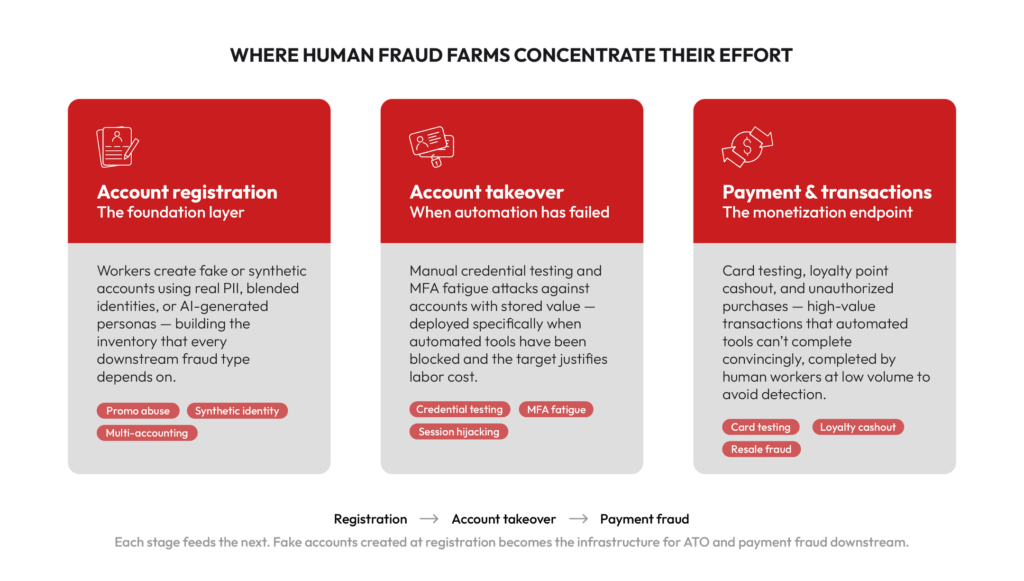
Human fraud farms concentrate effort at the touchpoints where fraudulent actions produce the greatest payoff.
Account takeover is where human fraud farms operate when automation has already been blocked. Workers use credential stuffing lists, purchased credentials, or phished login data to attempt manual takeovers. They target accounts with enough stored value (payment methods, loyalty points, trusted status) to justify the labor cost. Payment and transaction flows are the monetization endpoint. Human fraud farms execute the high-value transactions that automated tools can’t complete convincingly: card testing, loyalty point liquidation, unauthorized purchases for resale.
SMS verification abuse is an underrecognized vector that turns platform authentication infrastructure into attacker revenue. When platforms use SMS for OTP or account verification, human fraud farm workers bypass bot-gated flows to flood the SMS pipeline with fraudulent triggers. Every message sent to a premium-rate number the attacker controls generates carrier payout. The platform pays the cost. The attacker collects the margin. Fraud farm operations are deployed specifically for this because bot detection gates the flow — human behavioral signals are the key that unlocks it.
How AI Is Augmenting the Human Fraud Farm Threat
Human fraud farms were already the most sophisticated fraud threat most platforms face. AI is now compounding that sophistication at three distinct levels.
Scale without labor cost. AI agents can execute tasks at volumes no human workforce could sustain, at near-zero marginal cost per attempt. Operations that previously required dozens of workers can now run with a handful of operators managing AI-driven infrastructure.
Real-time adaptation. Human coordinators responded to defensive changes over hours or days. AI-assisted operations probe defense boundaries session by session, identify gaps in real time, and shift tactics mid-campaign without human intervention. They never get frustrated. They don’t quit. They iterate until the economics force them to stop.
Synthetic identity at volume. Fraud farms have always needed identity material, either real or stolen PI, to create convincing accounts. That supply was finite. Generative AI removes the constraint. Unlimited synthetic personas, with coherent backstories, plausible email patterns, and consistent behavioral profiles, can now be manufactured on demand.
The result is a three-layered hybrid: bots for volume, humans for verification bypass, and AI agents for scale, coordination, and identity generation. Each layer exploits a different gap. Each requires a different defense.
Why Human Fraud Farms Defeat Standard Detection Stacks
Traditional fraud defenses are built around a binary: human or bot. Human fraud farms invalidate that assumption. They pass challenge-response tests designed to stop automation. They produce interaction patterns that behavioral analytics score as legitimate. They use clean residential IPs that evade reputation-based blocking. And they operate at low enough volume per worker to stay below velocity triggers.
The individual session looks legitimate. It’s only at the pattern level, across sessions, devices, accounts, and flows, that the operation becomes visible. That requires cross-session, cross-flow intelligence that point solutions, by definition, don’t have.
What Comes Next in This Series
Understanding the threat is step one. In part two, we examine exactly why the most commonly deployed defenses fail against human fraud farms, and what that failure costs in measurable business terms. In part three, we make the case for the only defense model that works: economic deterrence.
Arkose Labs protects the world’s largest platforms from human fraud farms and other sophisticated fraud threats. Learn how the Arkose Titan platform’s economic deterrence model makes fraud operations unprofitable.
Share The Blog