Case Study
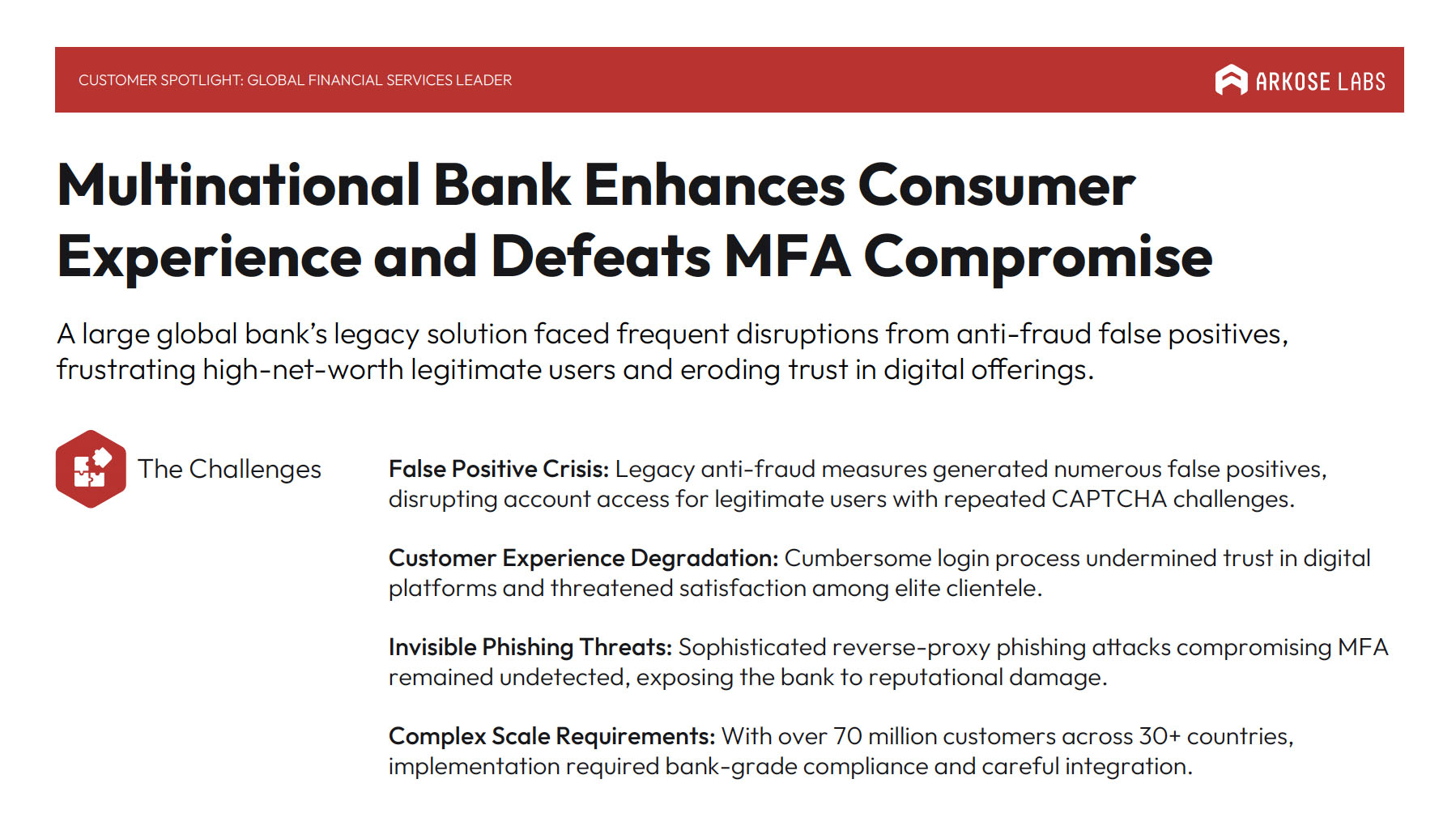
Arkose Labs Helps Multinational Bank Enhance Consumer Experience and Defeat MFA Compromise
Learn how Arkose Labs helped a top global bank reduce false positives, improve transparency into attack traffic, and mitigate numerous phishing domains.
What You’ll Learn
- How a global bank reduced customer friction while strengthening securityHow legacy anti-fraud tools were causing false positives that frustrated legitimate users—especially high-value clients—and how Arkose Labs restored a smooth login experience.
- Why transparency into attack traffic was essential for improving fraud preventionHow the bank’s previous vendor lacked visibility into risk signals, limiting the bank’s ability to understand threats and tune defenses effectively.
- How Arkose Labs delivered deep risk intelligence and high-fidelity detectionHow behavioral biometrics, device intelligence, anomaly detection, and inline analysis provided the bank with richer insights and more accurate decisioning.
- How Arkose Labs protected the bank against MFA compromise and phishing workflowsHow reverse-proxy phishing attacks were detected in real time through Arkose Phishing Protection’s token validation and threat intelligence model.
- How partnership and data sharing enabled long-term fraud resilienceHow close collaboration, explainability of risk signals, and ongoing tuning strengthened defenses across web and mobile login flows.
FAQ
Why was the bank experiencing so many false positives?
Legacy anti-fraud tools were misclassifying legitimate users as suspicious, especially during login. This caused unnecessary challenge loops—for example, repeated CAPTCHA selections—that disrupted access to critical services and eroded trust among high-net-worth customers.How did Arkose Labs improve detection and user experience at the same time?
Arkose Labs analyzed hundreds of risk signals—including behavioral patterns, device characteristics, VPN/proxy usage, and anomalies—to accurately differentiate legitimate users from attackers. Adaptive challenge flows were applied only when needed, reducing friction across the user base.How did Arkose Labs help the bank defend against MFA compromise?
Arkose Phishing Protection identified phishing sites masquerading as the bank’s login page by verifying whether each session presented a valid Arkose token. This exposed reverse-proxy attacks designed to intercept credentials and MFA codes, enabling fast mitigation and domain takedowns.What additional value did the bank gain from Arkose Labs?
The bank received clear explanations for why sessions were flagged, visibility into global threat patterns, and data that enhanced internal fraud models. This transparency allowed the bank to tune defenses, reduce friction, and strengthen trust in its digital channels.