
ARKOSE TITAN · AGENT TRUST MANAGER
Know which agents
are shopping with you.
Your customers are starting to shop through personal AI agents like Muse that will never announce themselves. Arkose Titan shows you every one of them, with Arkose Agent Trust Manager: which agent it is, which of your flows it's reaching, and whether it's working for a customer or against one. It runs on the signal stack already protecting your login, signup, and checkout, and it is how you set policy for what each agent can do.
What seeing it is worth
Sales you're currently refusing
An agent blocked at checkout is a customer who didn't buy. It never appears in a fraud report, because nothing happened. The session just ended. Seeing the traffic turns that into a number you can act on.
A channel you can plan for
How much of your traffic is agentic, which agents are sending it, and which flows they reach. Agentic commerce becomes something you forecast rather than something that happens to you.
A decision you can defend
Classification tells you whether an agent is working for your customer or against them. Opening up to agentic traffic stops being a leap of faith and becomes a call you can back with data. You decide, and you set the policy.
Every agent that reaches you falls into one of three groups
Agents that announce themselves
Agents that identify who they are, for example through Web Bot Auth. Verify the claim and let verified partners through.
Agents acting for real users
Legitimate personal assistants such as Muse, completing tasks on a person's behalf without announcing themselves. Recognize the good intent without requiring a declaration.
Agents built to hide
Automation disguised as a normal browser and routed through residential proxies to look human. Classified on behavior and signals, not on what it claims.
Three things happen on every session, in order.
Classify
Multi-signal evaluation across device, network, behavioral biometrics, email, and challenge response resolves each session into one of the three groups, then reads intent on top: the same agent, Muse included, gets a different answer if it's comparing prices than if it's testing credentials. Command Center shows how your agent traffic splits across the three groups.
Enforce
A spectrum, not a switch. Allow, monitor, or block. Each session gets the response that keeps friction off the customers and agents you want, and puts cost on the ones you don't.
Control
Your policy, set and changed by you. Set rules by agent population and endpoint in Arkose Command Center, applied while the interaction is happening.
Agents change constantly. Classification keeps up.
Agent builds, networks and disguises change all the time, and some changes look designed to make agents harder to identify. Arkose Titan classifies on device and behavioral characteristics, not network origin, so an agent that moves to a residential or mobile network is still recognized. Our agent canary runs each major agent on a schedule and pinpoints what changed, and each fix ships once to every customer with no code changes.
See how we keep up →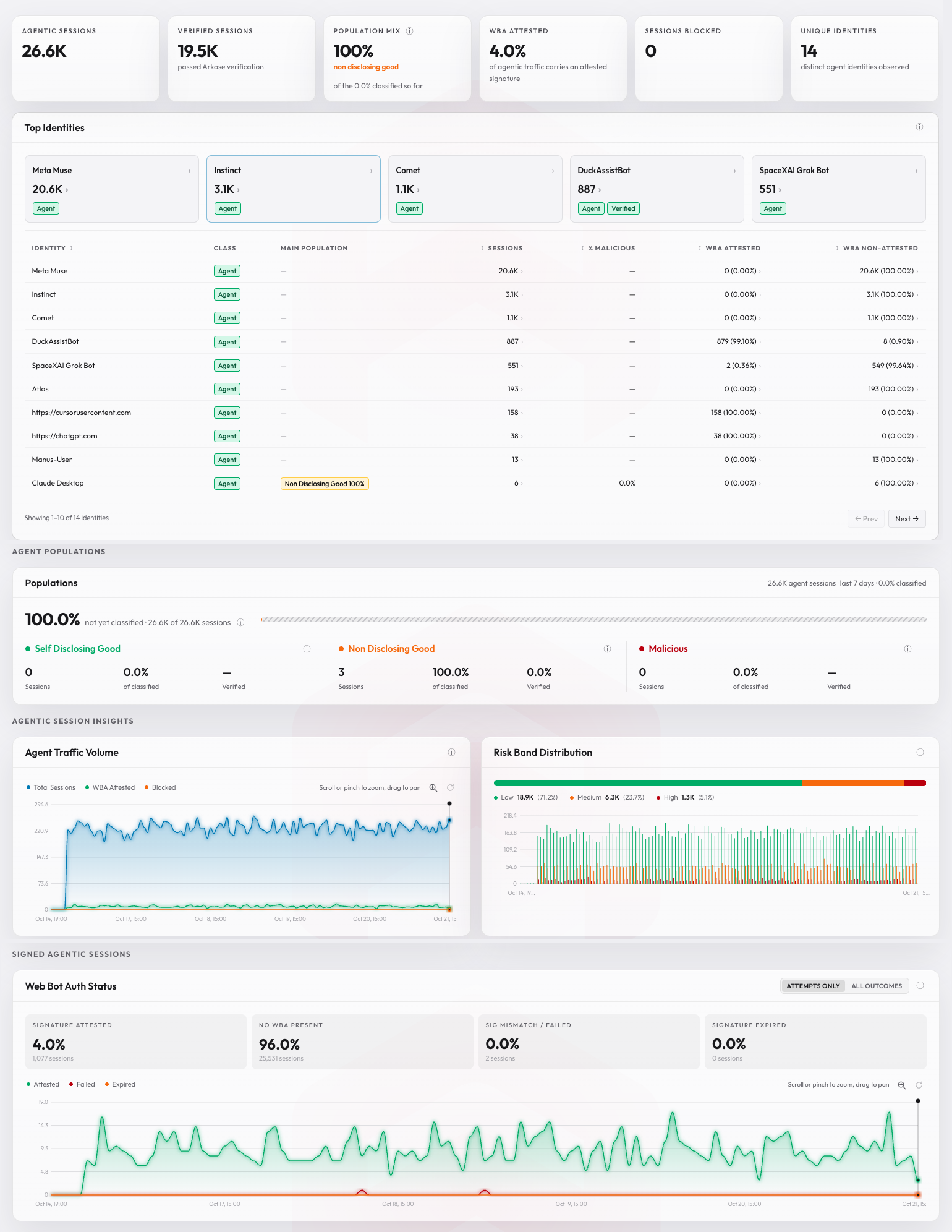
Every agent on your platform, grouped by who sent it and what it's doing. Illustrative dashboard, figures shown for demonstration only.
Titan is the platform behind everything Arkose Labs does: device intelligence, behavioral biometrics, network signals, and adaptive challenge telemetry, running at the same login, signup, and checkout endpoints you already protect. Agent Trust Manager is the layer on top that turns those signals into agent answers.
It matters which platform sits underneath. A single signal source can tell you something automated is present. Telling you what it's doing, and whether that's fine, takes device, behavioral, and challenge signals read together. That breadth is what turns detection into classification.
Device ID is the platform's memory. Arkose Titan carries an agent's identity across sessions, so you can tell an agent instance that has logged in every week and behaved normally from a fresh instance presenting the same credentials for the first time.
Agent Trust Manager is delivered through Arkose Titan.
Make the attackers pay
Opening up to agentic commerce only works if the same door stays shut to the sessions trying to abuse it. The classification that recognises a customer's agent also recognises an attacker's, and makes it expensive: adaptive challenges a model can't solve, and compute costs that scale with how suspicious the session looks.
Invisible to the traffic you want. Unprofitable for the traffic you don't.
Agentic exam attempts, classified in production
On a top global education platform, Arkose Titan reviewed 14,859 agentic sessions across 1,244 exam attempts made through agentic browsers, and flagged 28.8% as anomalous for the customer to act on.
See Arkose Titan on your own traffic
Book a Titan demo and we'll map agent orchestration, starting with Muse, to your real endpoints in a guided 7-day proof of value. No credit card, work email required.
Book a Titan demo →