Arkose Labs recently reviewed various 2023 security reports, confirming that phishing attacks are “now the most common form of cybercrime, with an estimated 3.5 billion spam emails sent every day.” Phishing has been with us for decades and consumers and employees fall for it daily. And what happens—customers give up the credentials for their banking accounts and employees click a link that allows malware to enter the employee’s company data center and sensitive data is exfiltrated and/or the company becomes a victim of ransomware. And we just can’t seem to get people to stop being phished.
As bad as it has been, it’s about to get worse. Welcome to the world of phishing and artificial intelligence (AI), especially generative AI (GenAI). This latest phishing scare has created a whirlwind of potential new and powerful capabilities. Now, with any new technology, there is always a heavy dose of skepticism that comes with it. But it has been 14 months, the jury is in, and has voted that GenAI is real for many use cases- and not all for the good. So, let’s take some time to understand what has happened and what is possible. Here are some of the documented capabilities of the new AI:
 According to Arkose Labs’ vice president of product Vikas Shetty4: “To make the reverse proxy attack more believable, the actor may obtain SSL/TLS certificates for the fake domain. This gives the appearance of a secure connection to the user”. Shetty goes on to say: “As users interact with the proxied fake site (bank, eCommerce, healthcare sites), the attacker collects sensitive information such as usernames, passwords, credit card details and any other data they’re targeting.”
He also describes how EvilProxy is a phishing-as-a -service model, where bad guys can just rent this service.
According to Arkose Labs’ vice president of product Vikas Shetty4: “To make the reverse proxy attack more believable, the actor may obtain SSL/TLS certificates for the fake domain. This gives the appearance of a secure connection to the user”. Shetty goes on to say: “As users interact with the proxied fake site (bank, eCommerce, healthcare sites), the attacker collects sensitive information such as usernames, passwords, credit card details and any other data they’re targeting.”
He also describes how EvilProxy is a phishing-as-a -service model, where bad guys can just rent this service.
- Easily translate text from one language to many languages, with incredible fluency.
- Write text and create a graphic.
- Write code to say, create a website or other applications.
- Convert a photo into a video and have the mouth and facial movement look realistic.
- Capture 3-10 seconds of a person’s audio and create an entire speech in that person’s voice (in possibly many languages). And the accent will sound good in these languages.
- Use a video of one person (a fraudster) to create video motion of a second person (an attractive male for a romance scam), just having a picture of the person.
Method 1
The fraudster will copy an FI’s web site with the only change being the domain name. The domain name will be a ‘look-a-like’ domain (again one character off or a Cyrillic character used). The customer clicks the link on the text message or email and is taken to the fraudster’s bank website. The customer logs into this bogus website and the fraudster collects the credentials. Afterwards, the fraudster may bring up an error page or maybe even take the customer to the real bank website.Method 2
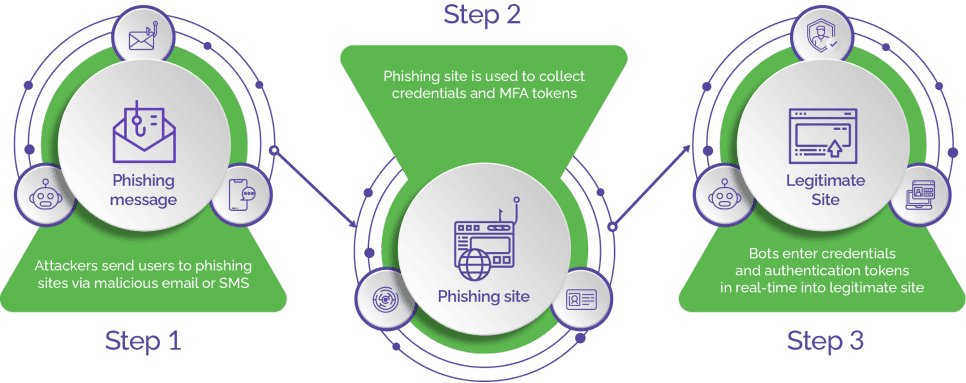
Method 2 is more complicated. Again, the fraudster copies the real bank website, but this time connects the bogus website to the real bank site. When the customer is taken to this bogus site, they enter their credentials. But this time, behind the scenes, the fraudster uses these credentials to successfully log into the real bank (a bot-type activity). If there is no additional authentication required (e.g. OTP code), the fraudster is in and can do unauthorized transactions. And the customer might be given a ‘site down’ message. But if there is additional authentication required, such as the OTP code, the fraudster will take this OTP code page from the real site and present it to the customer on the bogus website. The customer gets a text message with the code and enters it into the bogus site. The bogus site then collects the OTP code and via a bot, the fraudster will enter the OTP code into the real site and again can now do transactions. Chart 1 describes how these man-in-the-middle attacks work, using reverse proxies. One of the more effective man-in-the-middle programs is called EvilProxy.Chart 1 What is Man-in-the-Middle Phishing
According to Arkose Labs’ vice president of product Vikas Shetty4: “To make the reverse proxy attack more believable, the actor may obtain SSL/TLS certificates for the fake domain. This gives the appearance of a secure connection to the user”. Shetty goes on to say: “As users interact with the proxied fake site (bank, eCommerce, healthcare sites), the attacker collects sensitive information such as usernames, passwords, credit card details and any other data they’re targeting.”
He also describes how EvilProxy is a phishing-as-a -service model, where bad guys can just rent this service.
Summary
The new AI/GenAI capabilities will be picked up by the fraudsters to steal more money from frauds and scams. Although there will be several attack vectors fraudsters can use, for sure one of the most important and scalable attack vectors will be in phishing. And these new phishing attacks will be quite dangerous. Two final thoughts on how dangerous:- The UK’s cybersecurity agency, the National Cyber Security Centre warns: “Artificial intelligence will make it difficult to spot whether emails are genuine or sent by scammers and malicious actors5”
- Security expert Roger Grimes, says what really scares him is: “when you see AI interact and correspond in conversation with very realistic-looking responses6.” He says when a victim is suspicious of an email, they may reply back asking questions. But the new AI will allow for well-crafted legitimate-looking responses to the victim using the ‘industry vernacular’ in the correspondence.