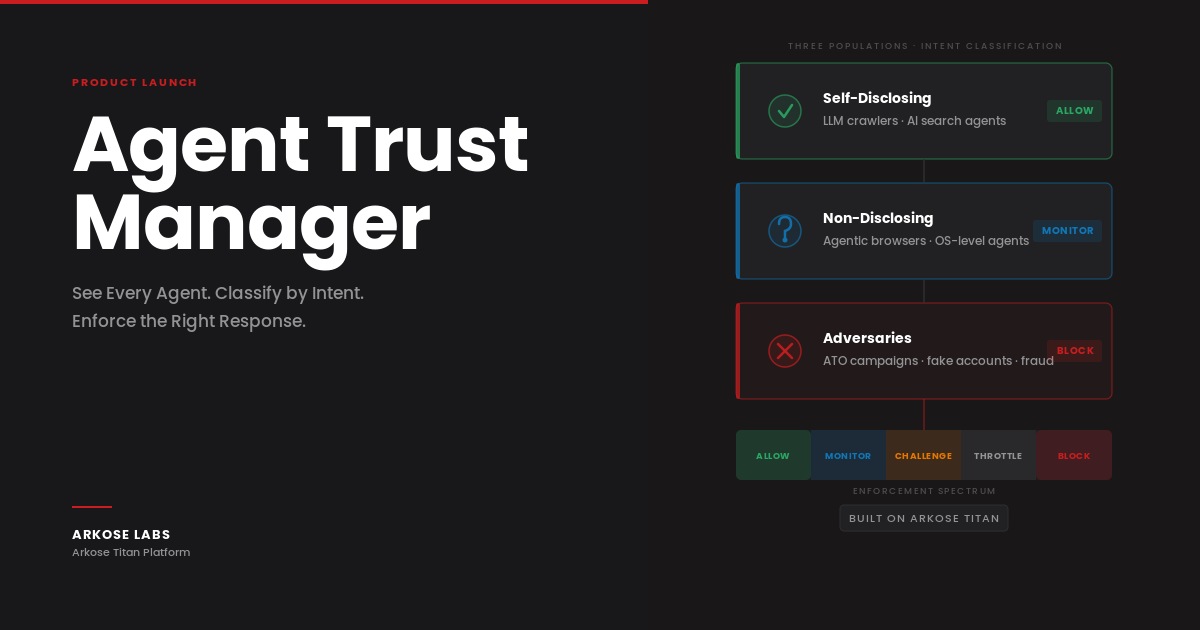
Arkose Agent Trust Manager, part of Arkose Titan, now classifies each AI agent session as self-disclosing good, non-disclosing good or malicious and lets you set allow, monitor or block policy at each step of your customer journey – all in the Command Center, your own console.
Something changed in customer traffic this year, and most businesses cannot see it. Consumers are sending personal AI agents to sign up, log in, check out and move money on their behalf. The agents are built to look like people, and they are good at it: personal AI agents, including Meta's Muse, identify themselves less than 3 percent of the time. If your detection waits for an agent to announce itself, you are not seeing the agents.
You cannot turn that demand away for long. Your customers want to use agents, and the businesses that say yes to the right ones will grow. But letting them through blind means fraud, liability and account risk you cannot measure or govern.
The question every fraud, risk and growth leader is asking is the same: which agents are in my flows, what kind are they and what should each one be allowed to do?
Answering it takes three things most businesses do not have today. You have to identify the agents, including the ones that look like people. You have to classify them, because an agent acting for your customer and an agent attacking your customer need different treatment. And you have to hold the policy yourself, step by step, so you can open the flows where agents bring you revenue and close the ones where they bring you risk, and change your mind as the agents change. Blocking everything leaves money on the table. Allowing everything is not a strategy. The businesses that grow with agents will be the ones that can tell them apart and decide, flow by flow, what each is allowed to do.
Arkose Agent Trust Manager answers that question. Here is everything we have released to answer it, in one place.
Know every agent, and what kind it is
Arkose Agent Trust Manager identifies the agents in your traffic whether or not they announce themselves, and classifies every agent session into one of three populations.
- Self-disclosing good agents sign their requests with Web Bot Auth, and the signature verifies. They tell you who they are, and you can check it.
- Non-disclosing good agents act for a real customer but never announce themselves. Muse is the best-known example, and most of the agents your customers use fall here.
- Malicious agents hide, misrepresent who they are or show high risk. A valid signature does not override a high risk score, because a valid signature does not rule out a compromised key.
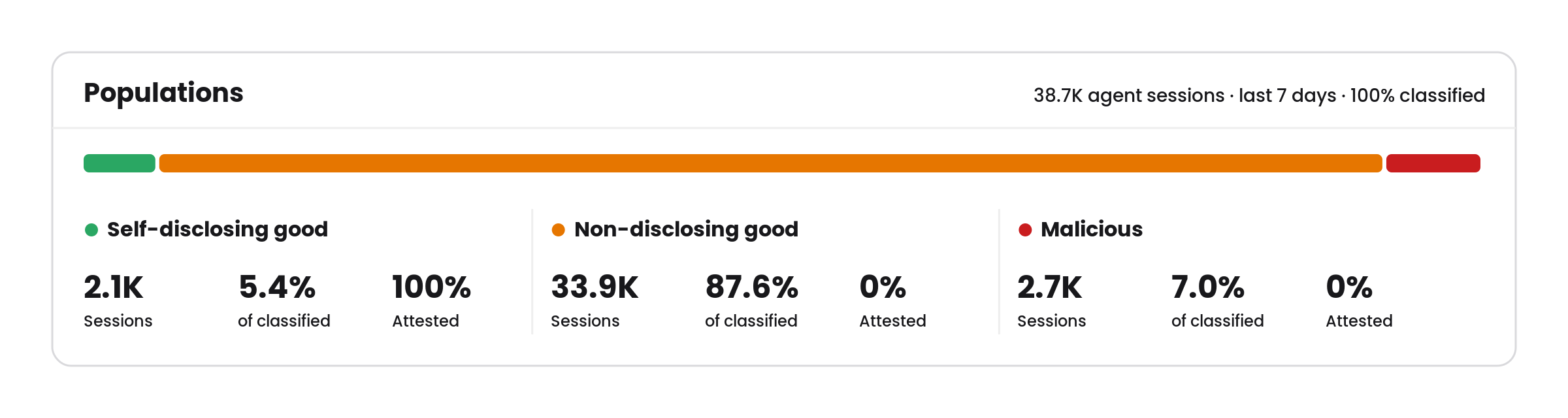
Population describes the session, not the agent, because the same agent can behave differently from one visit to the next. And a missing signature is not a red flag on its own; most agents do not sign today, so no signature puts a session in non-disclosing, not malicious.
You see all of it in the Command Center: which agents are on each key, how much traffic they drive, which are attested, how your traffic splits across the three populations and every session behind the numbers, filterable and exportable. The same numbers are available in your AI assistant if you would rather ask than click.
Decide what each agent can do, step by step
Knowing what kind of agent you are dealing with matters most when it decides what the agent can do. That is what orchestration is for. In Orchestrate, you lay your customer journey out as steps (e.g., sign-up, login, checkout and account changes) and choose a policy for each one: allow, monitor or block. You set the policy, and Arkose Titan applies it while the interaction happens.

Start in “monitor” to see what a policy would stop, then “enforce” when you are ready. Ten industry journey templates ship by default, and a short setup wizard recommends the one that fits your business. You can also set policy by population, so a step can welcome the agents your customers trust and close the door on the rest: let self-disclosing good agents browse, monitor non-disclosing good agents at sign-up and login while you learn what they do, block malicious agents everywhere and block every agent at the steps that move money or change credentials.
When your policy blocks a known agent, it gets a clear message in your brand, not a puzzle built for people: this workflow is not supported for agents, and here is where to go instead.
Follow the agent, not the IP
Agents rotate networks and ship new builds constantly, and IP and fingerprint rules break when they do. Cloud agents run in persistent virtual machines, and Arkose Agent ID persists inside them. The same agent keeps the same ID when the network rotates, when a new build ships and across every account it touches.
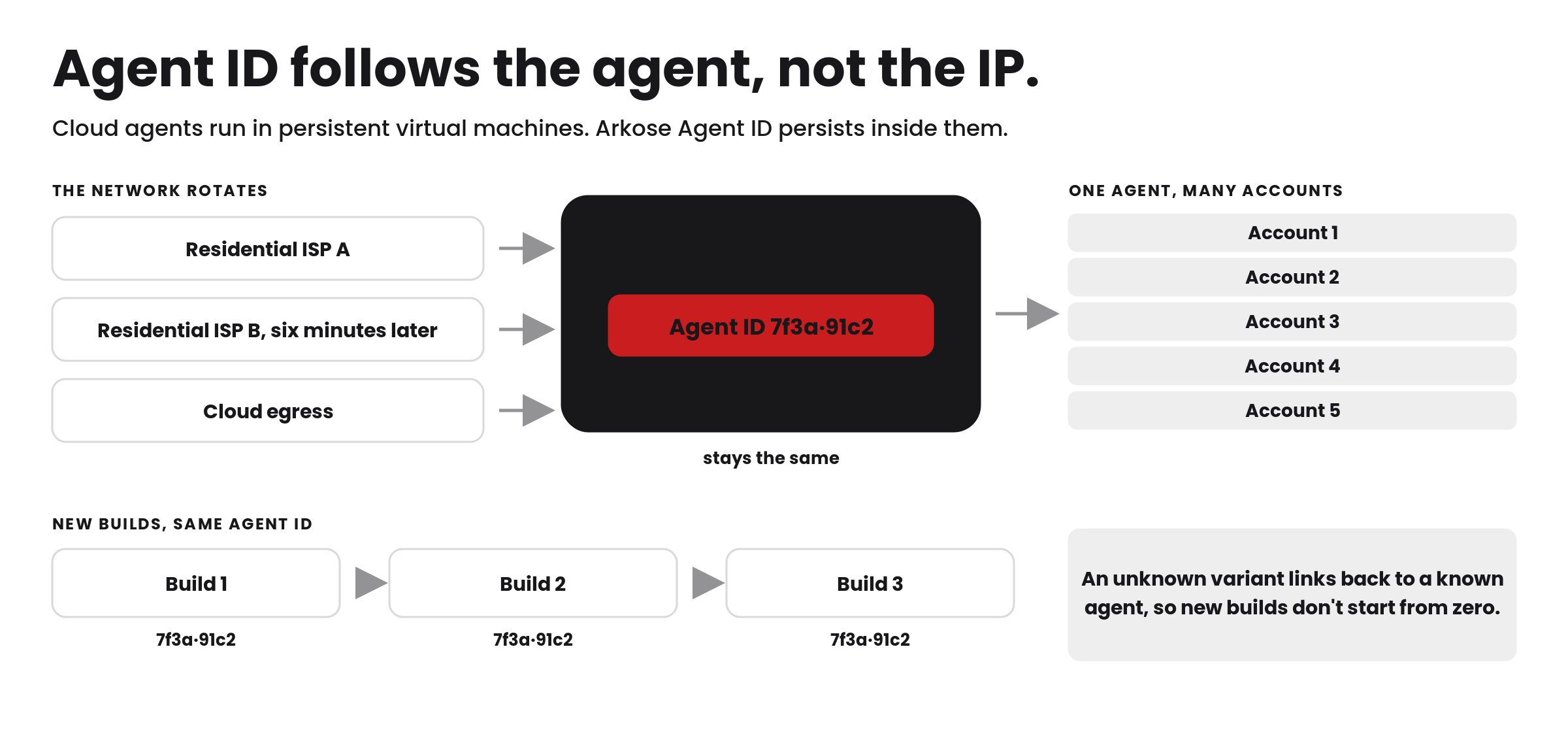
That changes what you can see. One agent opening 50 accounts becomes visible as one agent. An unknown variant links back to a known one, so new builds do not start from zero. Agent ID is the step from detecting agents to detecting risky behavior.
An audit trail for agent detection
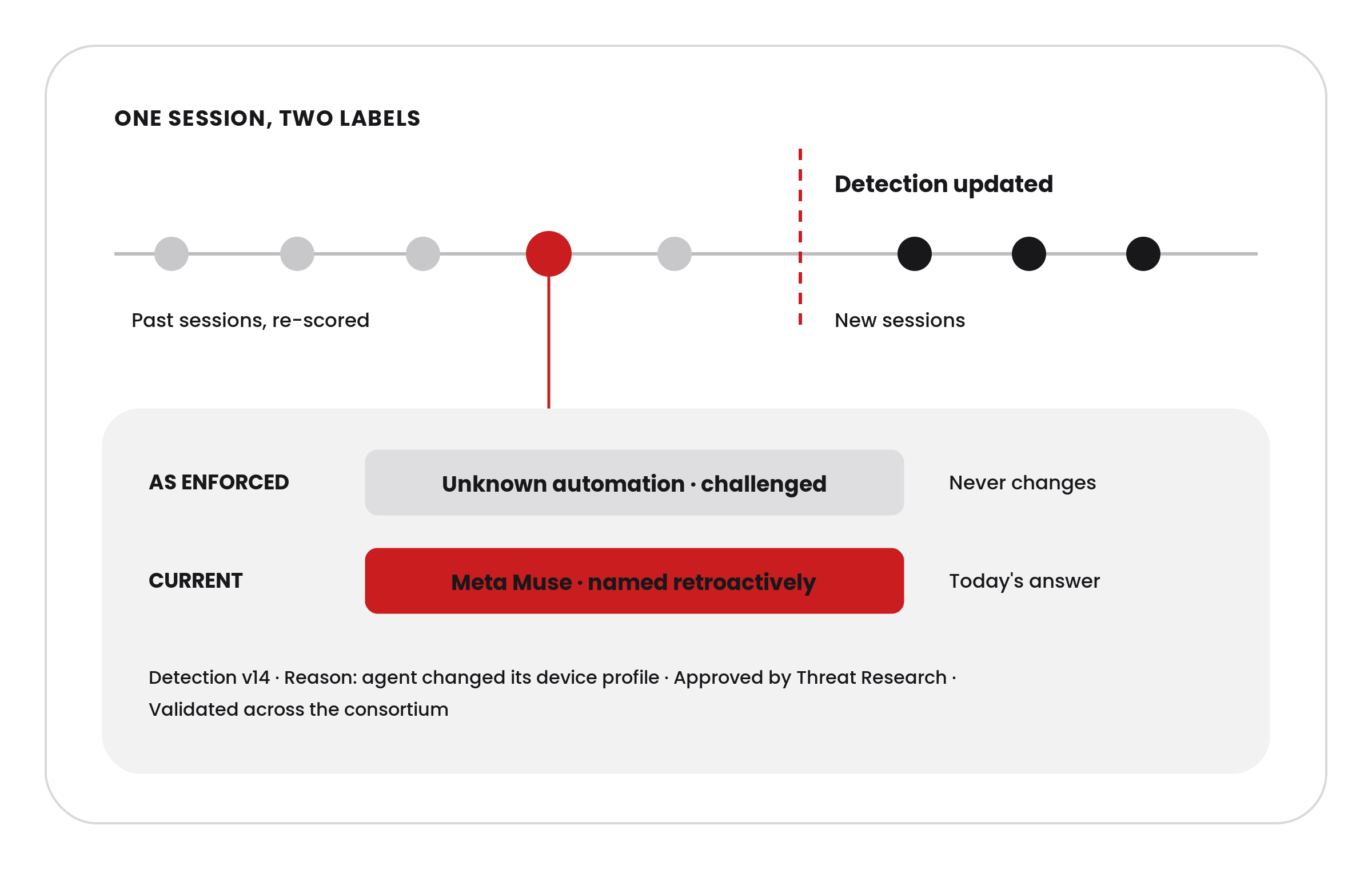
Agents change, and detection has to keep up. Detection auditing gives you an audit trail for agent detection: when our signals were updated, what each session was classified as at the time and what a new signal would have caught when replayed across past traffic. Every audit record is in the Command Center to review and export. When a new agent appears or a known one shifts how it shows up, you have a defensible audit record of what was known when. For a bank deciding who carries the liability for a money movement, that audit trail is the point.
And when a person has to be there
Some actions should never complete without a human. We are working on proof of human as an orchestration outcome: when an agent reaches a step you have marked as sensitive, it cannot continue until the person behind it confirms they are there. We will announce availability when it is ready.
All of it, in your hands
Every one of these capabilities lives in Command Center, your own console. You see what we detect, you share it with your team and your leadership, you set the policy and you watch it work. You decide where agents bring revenue and where they bring risk, and you can change that decision as fast as the agents change. We are ahead of the market on what we detect about agents. What sets Arkose Agent Trust Manager apart is that you get to see it and act on it yourself.
If you are already an Arkose Labs customer, you are already seeing agentic traffic in your Command Center. Arkose Agent Trust Manager turns that into classification, policy and control with no new integration. If you are not yet a customer, book an Arkose Titan demo and we will show you the agents in your traffic today.