Last week's The Latest in Agent Traffic looked at Meta Muse and Web Bot Auth. This week covers ARTEX, an open-source framework that lets an AI model decide how to attack. The FBI and other researchers have reported how fast it spread. Our research unit did something different: it tested ARTEX forks in a lab and watched how Arkose Titan scored them.
ARTEX is a pen testing tool and an agentic attacker in one
ARTEX is an open-source framework that gives an AI model a reconnaissance toolkit, a team of agents and a browser, then lets the model decide how to attack. Because a model plans each run, the tools, the order of steps and the requests change with the target.
Two things make it unusual. It works as a pen testing tool that probes your APIs. It also works as an agentic layer 7 harness, the software that lets a model act on the application layer, and it switches to a browser when the API door is locked.
The original developers reportedly closed the source, and many forks now exist. There is no single ARTEX to block.
How an ARTEX run works
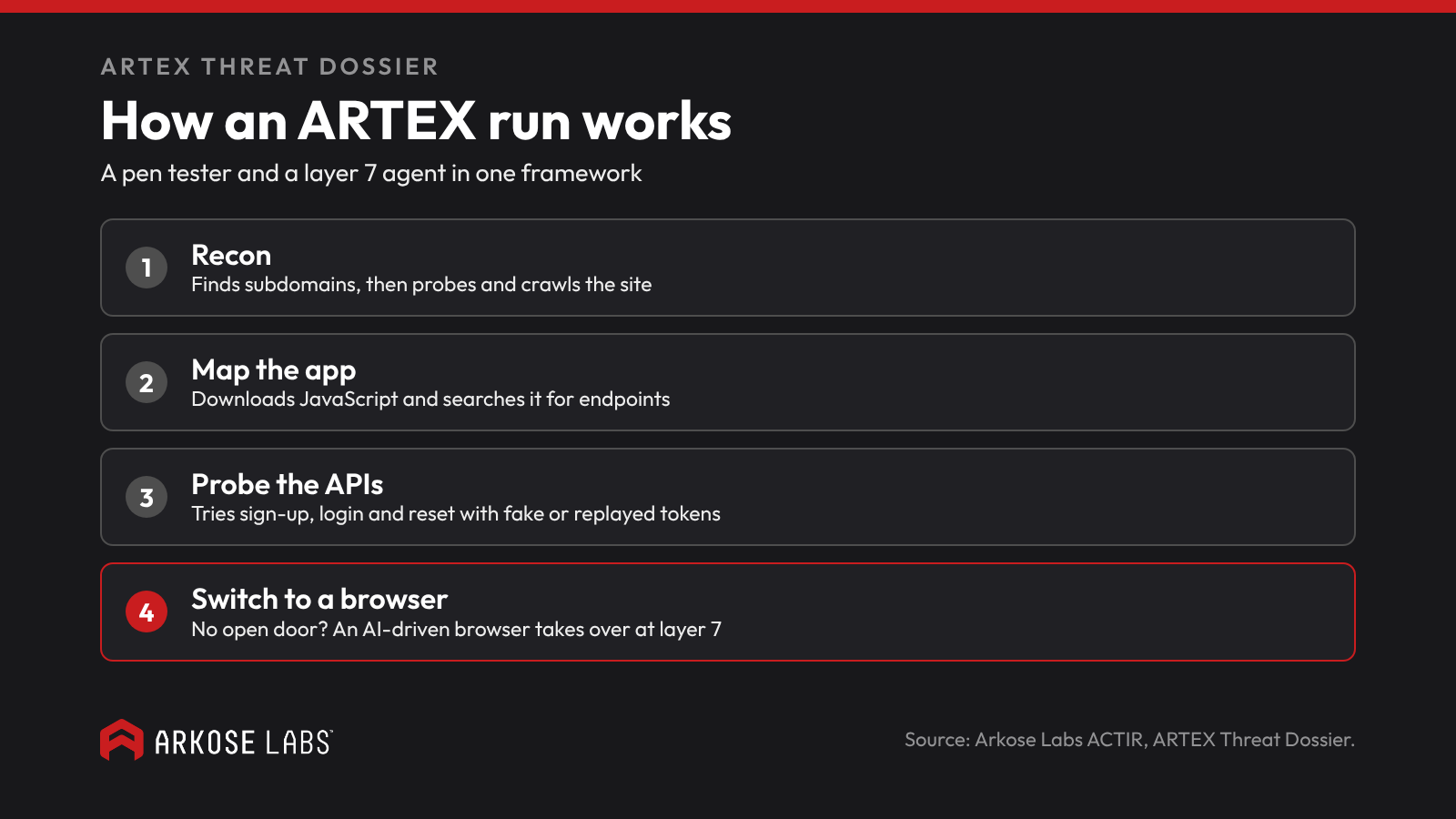
The ARTEX Threat Dossier from the Arkose Cyber Threat Intelligence Research unit (ACTIR) describes four steps in a run against a protected site:
- Recon. It finds subdomains, then probes and crawls the site.
- Map the app. It downloads JavaScript and searches it for endpoints.
- Probe the APIs. It tries sign-up, login and reset with fake or replayed tokens.
- Switch to a browser. With no open door, an AI-driven browser takes over at layer 7.
The model chooses the tools and the browser setup each time, so a run does not look the same twice.
Why it spread fast
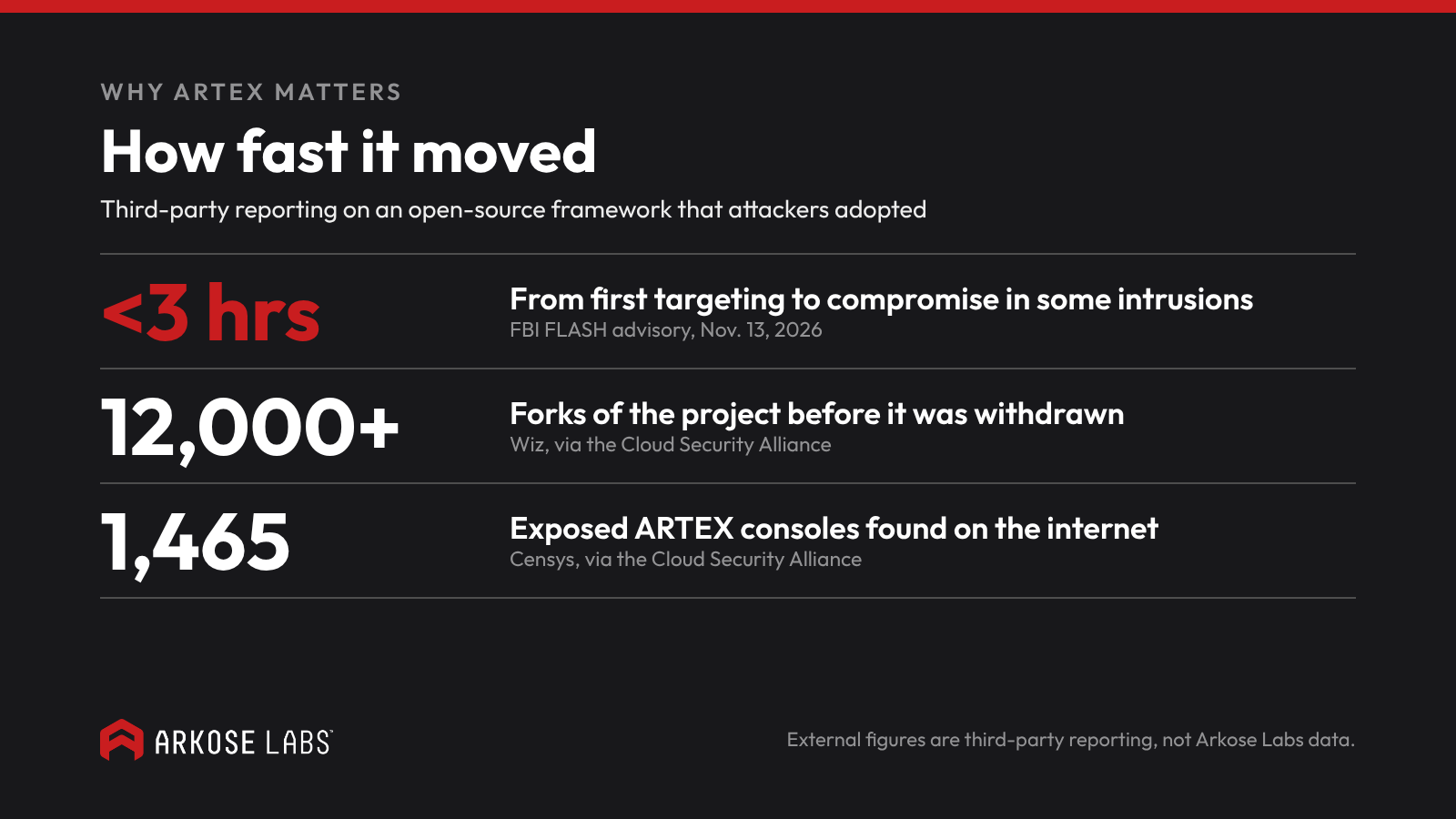
Third-party reporting shows how quickly ARTEX moved from release to real attacks:
- The FBI reported that some intrusions went from first targeting to compromise in under three hours (FBI FLASH advisory, Nov. 13, 2026).
- The project had more than 12,000 forks before it was withdrawn (Wiz, via the Cloud Security Alliance).
- Researchers found 1,465 exposed ARTEX consoles on the internet (Censys, via the Cloud Security Alliance).
What Arkose Titan saw
In ACTIR lab testing of public ARTEX forks, completed Nov. 5, 2026, Arkose Titan scored default ARTEX sessions 100 out of 100, the highest risk score it gives. Nothing in the browser layer names ARTEX. Default setups gave themselves away through standard automation behavior, such as headless browsing.
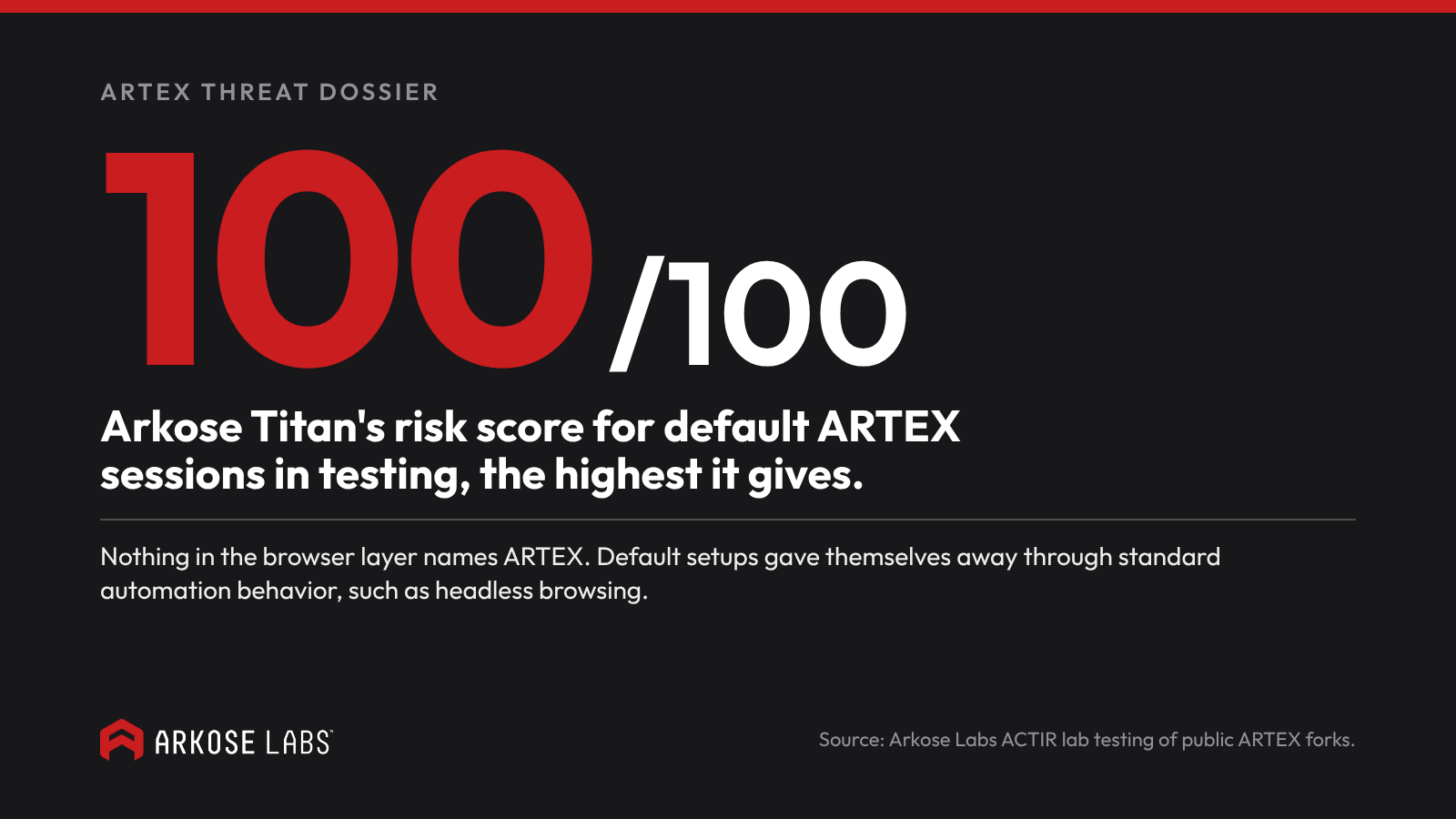
That is the point. An agent can claim to be anything, but it is harder to hide how it behaves. Arkose Titan classifies a session like this as a malicious agent from its device, network and behavior signals, so a changed IP address or a new fork does not reset detection.
The result comes from default setups in testing and is not a claim about every fork. Findings will change as forks change.
To act on it, use the Arkose Titan verdict in authentication rules to block, and verify Arkose Titan tokens server-side across sign-up, login and reset. Read the full ARTEX Threat Dossier.
Allow the agents you trust. Block the ones you do not. Which malicious agents are already in your sign-up, login and reset traffic? Book an Arkose Titan demo to see which agents are in your traffic and how each one behaves.
About the data
- ARTEX run steps and framework description: ARTEX Threat Dossier, Arkose Labs ACTIR, Nov. 9, 2026.
- Arkose Titan score of 100 out of 100: Arkose Labs ACTIR lab testing of public ARTEX forks, completed Nov. 5, 2026.
- Under three hours from targeting to compromise: FBI FLASH advisory, Nov. 13, 2026.
- More than 12,000 forks: Wiz, via the Cloud Security Alliance.
- 1,465 exposed ARTEX consoles: Censys, via the Cloud Security Alliance.