Last week's The Latest in Agent Traffic reported that Meta Muse began signing its requests with Web Bot Auth on Nov. 6. New data from the Arkose Labs Global Consortium shows how far that rollout has gone and which agents still are not signing.
Meta Muse is now 40% signed
On Nov. 6, Muse started signing its requests with Web Bot Auth, a standard that lets an agent sign each request so a site can check who sent it. The switch took about three hours, and Muse traffic volume did not change. By Nov. 9, 40% of Muse sessions carried a signature, up from none on Nov. 5 and up from about a third on the first day.
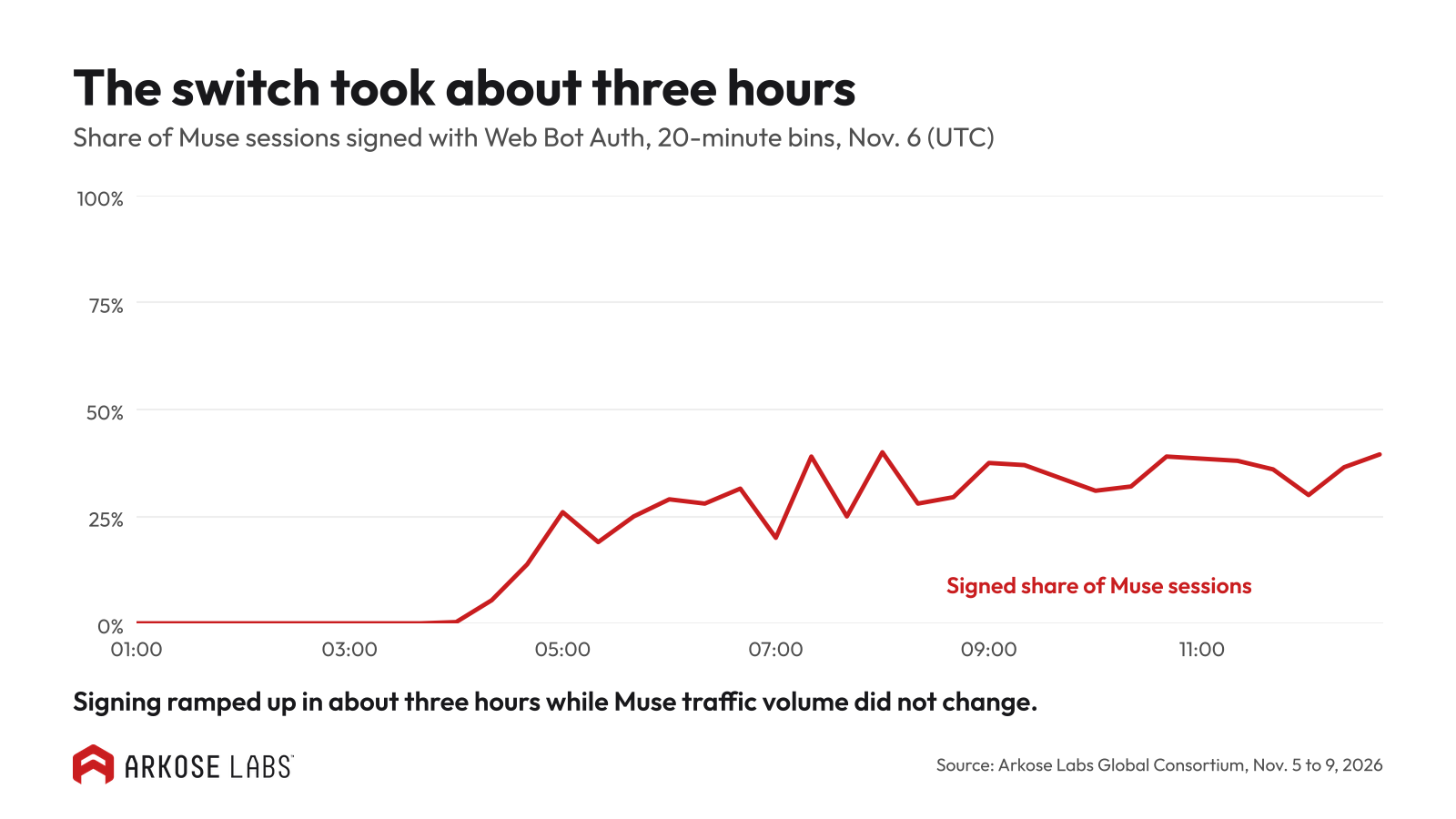
Meta is signing part of its fleet, not all of it. The other 60% of Muse sessions still arrive without a signature.
For the signed sessions, we check each signature against the key Meta publishes. A match attests who sent the request, so the agent's origin is attested, not inferred.
Who signs and who does not
ChatGPT agents and Google Agent signed 100% of the sessions we saw on Nov. 9. Meta Muse signed 40%. Claude Desktop, Instinct, Grok Bot and Perplexity Comet signed none.
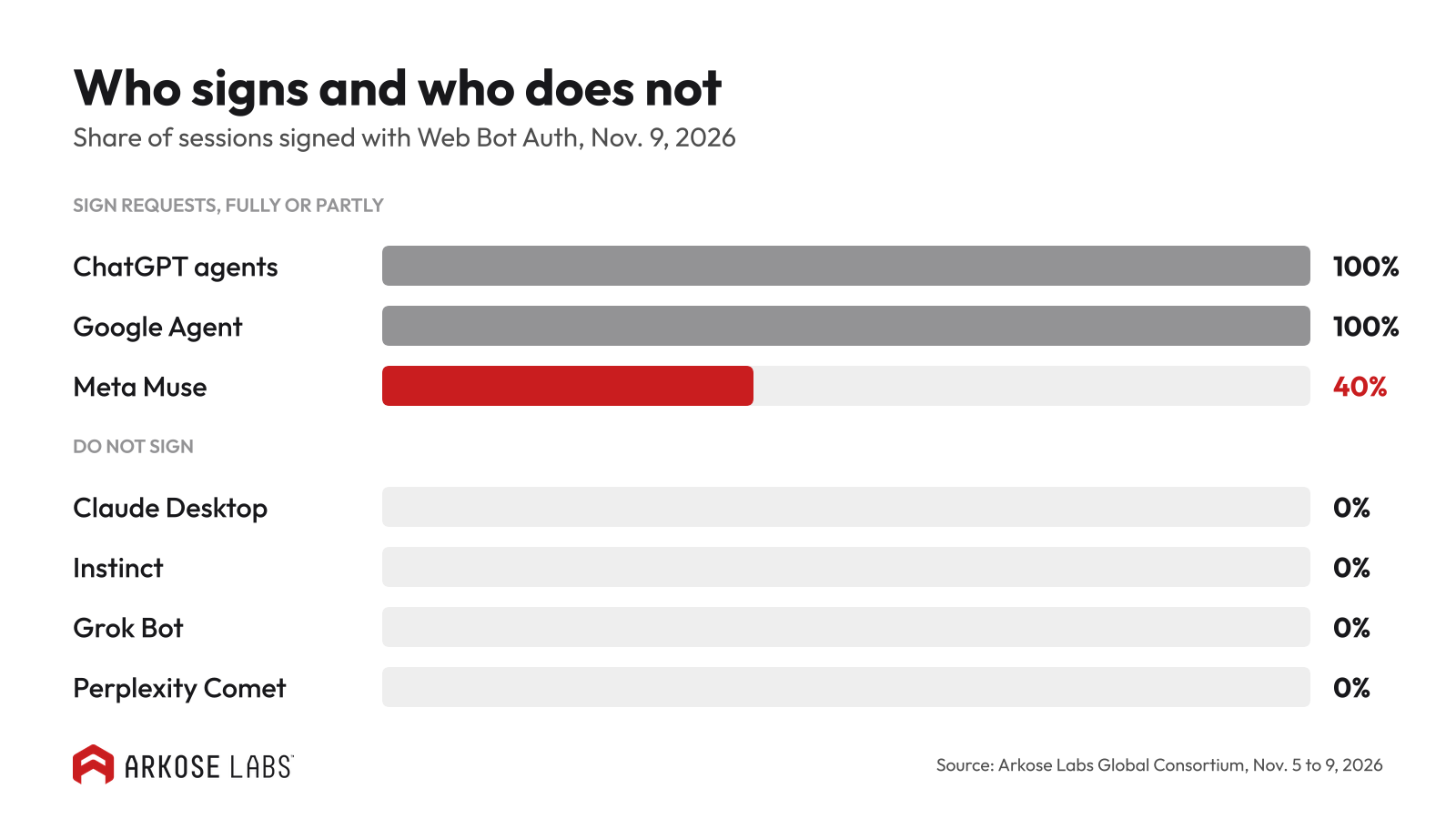
A missing signature is not a red flag. Most agents do not sign today, so a session without one is classified from its device and behavior signals instead. That is why a single agent can show up in more than one population: a signed Muse session is self-disclosing good, and an unsigned one is non-disclosing good.
What this means for your business
For businesses, that means two kinds of Muse traffic: sessions with an attested origin, where you decide where to let the agent in, and sessions that still arrive without a signature.
Signing helps with agents that cooperate. It does not replace detection, because every agent that skips signing still has to be classified from how it behaves.
Which agents are you letting in on trust alone?
Book a Titan demo to see which agents are in your traffic and how each one behaves.
About the data
All figures come from the Arkose Labs Global Consortium, Arkose Labs' network of customer traffic, Nov. 5 to 9, 2026.
- Meta Muse signing: share of Muse sessions with a Web Bot Auth signature, 20-minute bins, Nov. 6, 2026 (UTC)
- Signing by agent: share of sessions signed with Web Bot Auth, Nov. 9, 2026