
There is a question that sits beneath the design of every challenge-response system, usually unasked: what happens when the attacker can solve it?
For traditional CAPTCHAs, the implicit answer was: they can't. That assumption, that a challenge can rely on a fixed correct answer, is what breaks down once AI vision models are involved. A durable fix has to make solving cost more than the attack is worth, regardless of how capable the attacker's model becomes.
The assumption collapsed when computer vision capabilities crossed the threshold where the same systems used to train image classifiers could be turned against challenge formats built on the same imagery. Every design decision in Arkose MatchKey is a direct response to that failure, and to the attacker research described in Blog 3.
Arkose MatchKey's answer to the question is different: solving it will cost more than it's worth. That is a durable answer because it doesn't depend on the attacker's capabilities being fixed. It depends on the economics being unfavorable regardless of capability level.
The Core Mechanism: Per-Round Key Images
In a standard classification challenge, the correct answer is defined by a fixed class. A door is always a door. An attacker building a solver doesn't even need to identify the right answer directly; they can eliminate wrong answers and build inventory through sessions without ever solving correctly. The attack surface is bounded by the number of answer classes, and a determined solver can exhaust it.
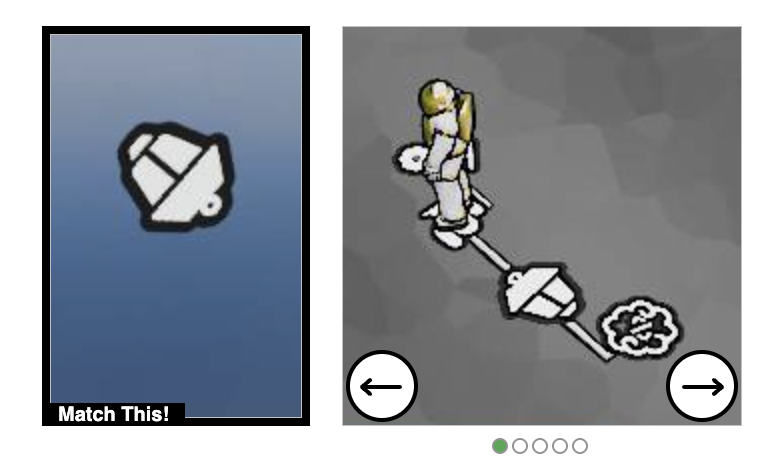
Arkose MatchKey eliminates this entirely. The correct answer is defined by a key image shown each round, not a fixed class. A door may be correct when the key image is a door, and incorrect in the next round when the key image is a chair. The correct answer changes every round, which means class-based enumeration attacks have no purchase and there is no static inventory to build.
For an agentic AI attacker relying on session-to-session learning, this has a specific consequence: what one session learns about which answers are correct is not transferable once the key image changes. The cross-session learning advantage that makes agentic AI particularly dangerous is architecturally undermined at the level of the core mechanic.
Solving Space Breadth and AI Resistance
No single AI model, however capable, is simultaneously expert at every category of visual reasoning. Object detection, counting, spatial orientation, and physical reasoning each draw on different underlying capabilities, and strength in one doesn't transfer to the others. Arkose MatchKey's challenge portfolio is built around that gap, spanning more than fifty puzzle types because breadth itself is the defense.
Challenges anchored in physics-based tasks, time-based tasks, illusion-based tasks, and abstract problem spaces exploit cognitive spaces where human intuition operates naturally but AI inference does not. Spatial reasoning challenges, which require understanding rotation, depth, and physical relationships between objects, produce the weakest AI solver performance. The portfolio is deliberately anchored toward the task types where the gap between human intuition and machine inference is widest.
Adversarial perturbations, modifications imperceptible to human viewers, can exploit specific failure modes in how modern vision models interpret images. Arkose MatchKey incorporates this approach directly. Developed through direct evaluation of state-of-the-art multimodal models, these perturbations are most effective in three-dimensional and depth-dependent formats. The evaluation program is continuous: as model capabilities evolve, the perturbation design evolves with them.
Any attacker facing a broad, continuously evolving challenge portfolio is left with a poor choice: build a general-purpose model that performs inconsistently across task types, or build a portfolio of specialized models, one per category, that is expensive to build and maintain as new puzzle types are added. Neither option makes economic sense when easier targets exist. Arkose MatchKey's portfolio is designed to force exactly this choice.
Multi-Puzzle Games and Compounding Cost
In a standard session, an attacker can learn what puzzle type they face before committing. Multi-puzzle games eliminate this by serving different puzzle types within a single session, unknown at game setup. An autonomous agent cannot know which solver to deploy before the session begins, cannot abandon without forfeiting sunk cost, and cannot scrape novel puzzle types introduced late in the session without having already committed through earlier rounds.
Every element of Arkose MatchKey's architecture also generates detection signals as a byproduct. Per-round solve times, answer patterns, failure signatures, and session abandonment rates all flow back into the detection model continuously. Attack campaigns against Arkose MatchKey do not produce diminishing returns for the defender; they produce compounding ones. The longer an attacker persists, the more precisely the system is calibrated against their specific techniques.
What makes Arkose MatchKey different:
- Correct answers are defined by a key image shown each round, not a fixed class, so there is no static inventory for a solver to build
- The challenge portfolio spans more than fifty puzzle types across object detection, counting, location matching, orientation matching, and spatial reasoning
- Targeted perturbations, invisible to human viewers, exploit specific failure modes in how modern vision models read images
- Multi-puzzle games serve different puzzle types within a single session, unknown at setup, so an attacker can't pick a solver in advance
- Every solve attempt generates detection signals, so sustained attacks make the system harder to beat over time instead of easier
"Agentic AI has given attackers better tools. Arkose MatchKey was designed knowing this day would come, because every attack attempt, human or AI, is also data that makes the next challenge harder to solve." – Whitney Constantine
Visual challenges are only half the story. Blog 5 covers the audio challenge: why the industry treats it as a compliance checkbox, why that's the wrong frame in the age of agentic AI, and why Arkose Labs' sound-based approach is the only audio design that is simultaneously secure, accessible, and capable of distinguishing legitimate AI accessibility agents from malicious automation.
Continue Reading: The Disrupting Fraud Economics Series
Blog 1: The Economics of Fraud Have Changed. Here's Why.
Blog 2: We Are Not a CAPTCHA — Why the Turing test model is obsolete
Blog 3: What Attackers Taught Us — Proprietary attacker data that shaped MatchKey
Blog 4: Inside MatchKey — Architecture designed to make attacks economically irrational (this post)
Blog 5: The Audio Challenge — The only audio challenge that is both accessible and secure
Blog 6: Challenge Engineering Built to Withstand AI-Powered Attacks — The engineering beneath the challenge
Blog 7: Intent, Not Identity — Introducing Arkose Agent Trust Manager