
At the end of our recent blog series, Disrupting Fraud Economics in the Time of Agentic AI, we teased a question we had circled without landing on directly: in a world where both the attacker and the legitimate user may be an AI agent, what role do visual challenges actually play?
It is a fair question, and it deserves a direct answer. So here it is.
AI agents did not make visual challenges obsolete. They exposed what visual challenges were always for. The primary function was never verifying humanity. It was generating behavioral signal and imposing economic cost on attackers. Both functions matter more, not less, when network-layer identity signals like device fingerprints and IP reputation can be spoofed at scale, because an agent's conduct inside an interaction is far harder to manufacture than the identity it presents at the perimeter.
For two decades the challenge layer was judged against a test it was never really running. Agents did not break that test. They made it obvious that it was the wrong test, and that the valuable work had been happening somewhere else the whole time. To see where, we have to let go of what we think challenges are for.
Are visual challenges obsolete in the age of AI agents?
CAPTCHA, formalized by Carnegie Mellon researchers in the early 2000s, was built to tell computers and humans apart. The implicit logic was: verify humanity, grant access. That logic shaped how the security industry thought about challenges for two decades. And it is the source of the question being asked now.
It is also the source of CAPTCHA's negative reputation. A binary good/bad filter offers no way to categorize false positives and handle them accordingly, and no way to derive intent. So as attackers grew more sophisticated, the only lever challenge providers had was more friction, for everyone. That created a negative feedback loop, degrading the experience for legitimate users faster than it deterred attackers, and it is why "CAPTCHA" became a word most providers now avoid.
If challenges exist to verify humanity, then a world full of AI agents breaks the model entirely. You cannot verify humanity in something that is not human. So the challenge layer becomes either a barrier that harms legitimate agents or a gate that sophisticated malicious ones learn to pass. Either way, it sounds like the wrong tool.
But challenges were never primarily about verifying humanity. That was the use case they were designed around. It was not their most valuable function. Their most valuable function was always generating behavioral signals and imposing economic cost. And neither of those functions requires a human on the other side.
Most of the industry still talks about challenges as a binary wall against attackers. That framing is exactly what the agent era breaks, which is why we stopped using it.
What does a visual challenge actually measure?
A challenge interaction is a rich source of behavioral data. Every challenge interaction generates:
- Solve speed per round — how long each step takes, not just the session total
- Answer patterns — which choices are made and in what order
- Navigation behavior — how the session moves through the interface
- Failure signatures — what a wrong answer looks like, and what follows it
- Timing distributions across rounds — whether pacing varies the way human attention does
Every one of these signals carries information about how the session is operating, regardless of whether the agent is human, scripted or autonomous AI.
Passing a challenge and passing it invisibly are two different achievements. An AI agent operating at machine speed still leaves timing traces that no human nervous system produces. A fraud farm operator solving manually still exhibits patterns no organic user generates. The binary outcome, pass or fail, discards all of this. The signal is in the interaction itself, not in the verdict at the end.
This is the argument we made in We Are Not a CAPTCHA: the challenge is an intelligence sensor, not a gate. Every session, regardless of outcome, generates behavioral signals that feed the detection model. The challenge gets smarter with every interaction, including every interaction that passes.
Economic deterrence in fraud prevention means imposing enough cost per attack attempt that running the campaign becomes unprofitable. Network-layer blocking costs an attacker nothing beyond a blocked session. A visual challenge imposes real cost: labeling investment to build a solver, compute time to run it, ongoing maintenance as the challenge evolves and compounding detection signal from every attempt.
A well-resourced autonomous AI campaign can bypass a fingerprint check at near-zero marginal cost. Making the economics of attacking Arkose MatchKey, the Arkose Labs visual challenge, work is a materially different proposition.
Why do visual challenges matter more, not less, against AI agents?
The reason visual challenges are more important now is precisely what makes the agent era feel threatening to them. Network-layer identity signals have already been commoditized as attack vectors.
Across Arkose Labs' customer base, 74% of adversarial sessions spoof browser values and 69% fake macOS environments. Device fingerprints, IP reputation, session tokens: these are the signals that most security approaches rely on to make classification decisions. They are also the signals that agentic AI attackers have already learned to fake, systematically, at scale, before the first attack session even launches.
A platform that relies on what an agent appears to be at the network layer is looking at signals that have already been compromised.
Once identity can be manufactured, conduct is what is left to measure. The interaction layer is where conduct is observable, and where faking it convincingly costs an attacker something. An AI agent can present a perfect browser fingerprint, a residential IP and a valid session token. It cannot replicate the micro-timing variations of human cognition under real task load or the behavioral inconsistencies that emerge when an autonomous system encounters a challenge type outside its training distribution.
That signal only exists inside the challenge interaction, which means the challenge layer is not a relic of the human-versus-bot era. It is one of the few remaining surfaces where agentic AI attackers cannot fully control what they reveal.
Should every AI agent be challenged?
No. The right question is not whether to challenge AI agents, but which ones, and what the interaction reveals.
Arkose Labs' Allow/Monitor/Challenge/Throttle/Block enforcement spectrum provides the operational answer. It maps onto the three agent populations: self-disclosing good agents, non-disclosing good agents and adversaries.
| Enforcement step | Applies to | What happens and why |
|---|---|---|
| Allow | Self-disclosing good agents | Pass without friction. Intent is declared and verifiable |
| Monitor | Known legitimate agents operating within declared parameters | Pass, with behavior logged. No challenge needed, but signal still accrues |
| Challenge | Sessions where intent cannot be confirmed from network signal alone | Routed through the challenge interaction, where conduct becomes observable |
| Throttle | Non-disclosing good agents | Transact at reduced velocity. More precise than blocking, preserves legitimate commerce, keeps collecting signal |
| Block | Adversaries | Denied. Economic deterrence applied where behavioral signatures cannot hide behind a spoofed identity |
The Throttle step is particularly relevant here. Not every ambiguous agent should be blocked. A non-disclosing good agent, an AI assistant that does not announce itself but is acting for a real user, can be allowed to transact at reduced velocity while the system continues collecting signals. That is a more precise response than blocking, and it preserves legitimate commerce that blunt blocking would cut off.
How does Arkose MatchKey work against AI agents?
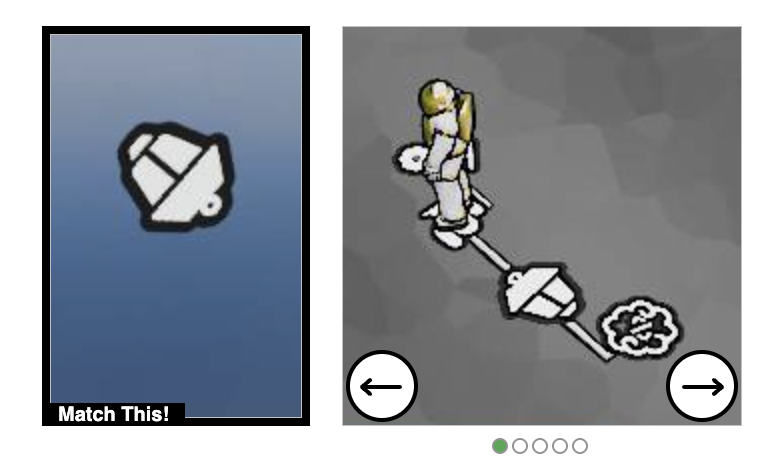
Arkose MatchKey is the Arkose Labs visual challenge. The architecture behind it was not designed to verify humanity. It was designed to generate behavioral signals and impose economic cost against the most capable automated attackers available.
- Per-round key image model — no static answer inventory for an AI solver to build against
- Solving space breadth — no single model is expert across all task types
- Multi-puzzle game structure — an autonomous agent cannot know which solver to deploy before committing to a session
- Compounding signal — every attempt, whether from a human operator, a scripted bot or an autonomous AI campaign, generates detection signal that improves the model
One detail that makes this concrete: challenge generation is built around guardrails and restrained variation. Every puzzle stays within boundaries that keep it intuitive and usable for legitimate users, while the system remains flexible enough to release millions of different iterations of a problem space. An attacker who invests in training a solver against today's challenges is forced to retrain every time that space shifts. The only path to a reliable solver is to generate a new labeled dataset from scratch, by running sessions against live challenges and annotating the results, and then to keep regenerating it as the challenges evolve. That is exactly the labeling-cost problem the architecture is designed to make economically irrational. The variation is not incidental. It is part of the defense.
This matters most for the footprint where compute is not the bottleneck. A local agent running on a customer's own device has cycles to spare, so friction that only taxes computation does not tax it meaningfully. The economics Arkose MatchKey imposes are different: the cost is retraining a generalizable solver every time the puzzle space shifts, which is a labeling and engineering cost, not a compute cost, and not a difficulty or friction cost either. The variation comes from new visual assets and small presentational changes, not from making the puzzle harder or slower to solve, so the legitimate user never feels it. That distinction holds whether the agent is cloud-hosted, a local browser agent or a local OS-level agent driving a real browser.
None of that depends on the attacker being human. All of it becomes more valuable as attackers become more capable.
"The challenge is not asking 'are you human?' anymore. It is asking 'does the behavioral pattern of this interaction suggest authorized intent?' That is a better question. And it is one that visual challenges, built on the right architecture, are uniquely positioned to answer."
What is the challenge layer for now?
The framing that makes the challenge layer feel obsolete in the agent era, that its purpose is to verify humanity, was always the wrong frame. The right frame is this: the challenge is the mechanism that makes intent legible at the interaction layer, where conduct cannot be spoofed, where economic deterrence can be applied and where the signal that distinguishes authorized agentic commerce from malicious automation actually lives.
In that frame, the agent era does not threaten the challenge layer. It is exactly what the challenge layer was built for.
Continue reading: The Disrupting Fraud Economics series
- Blog 1: The Economics of Fraud Have Changed. Here's Why.
- Blog 2: We Are Not a CAPTCHA — Why the Turing test model is obsolete
- Blog 3: What Attackers Taught Us — Proprietary attacker data that shaped MatchKey
- Blog 4: Inside MatchKey — Architecture designed to make attacks economically irrational
- Blog 5: The Audio Challenge — The only audio challenge that is both accessible and secure
- Blog 6: Challenge Engineering Built to Withstand AI-Powered Attacks — The engineering beneath the challenge
- Blog 7: Intent, Not Identity — Introducing Arkose Agent Trust Manager