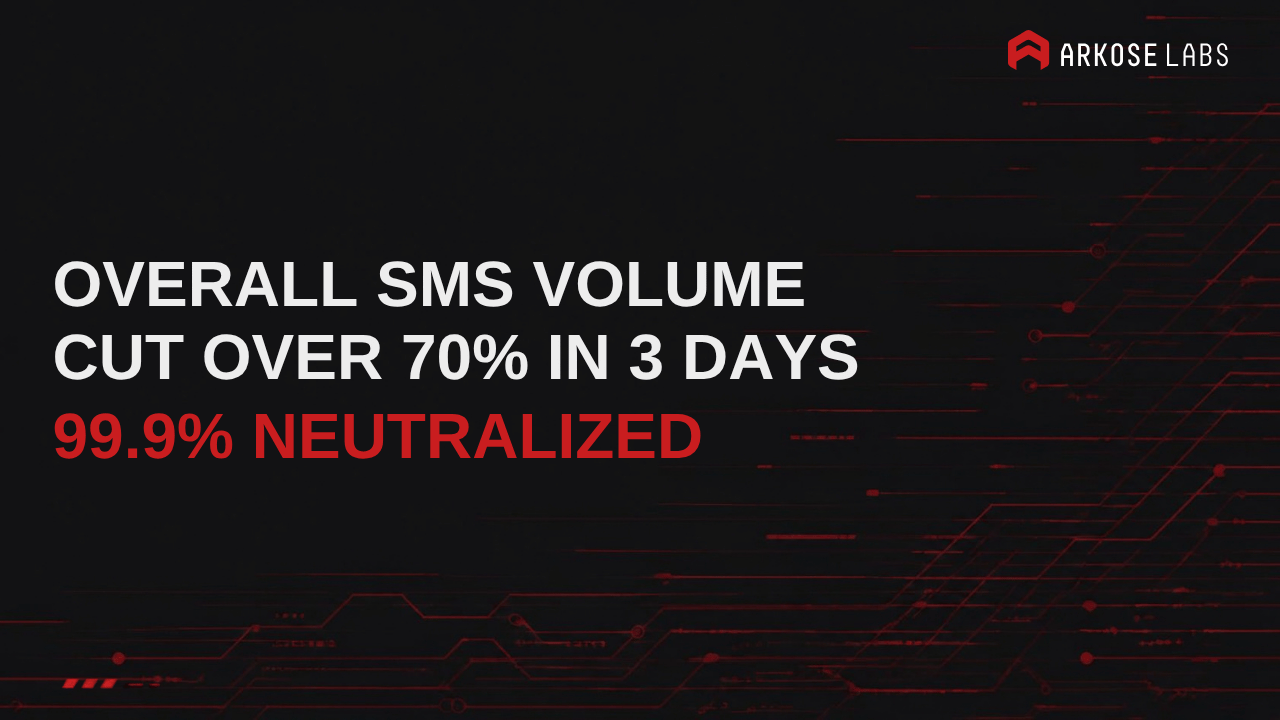
When fake accounts run up massive charges from premium-rate SMS verifications, you're stuck with the bill. It's time to use Arkose Bot Manager to shut down SMS toll fraud scammers and save your business millions in fraudulent charges.

Filter out the fraud to ensure that only legitimate SMS traffic is routed and billed.

Stop carrying the cost of fraudulent SMS schemes and start seeing the bump to your bottom line.

Minimize the need for extensive manual intervention and keep operations resource demands and costs in line.
Combining an improved security posture for end users with the ability to remove bad actors from the platform and demonstrate direct cost savings for the organization is a trifecta of good.
Attackers get in and out quickly, leaving you with a massive bill.
Criminal organization and attacker identify businesses with SMS touchpoints.
Attacker integrates these numbers into applications and systems.
Fraudulent SMS flows traverse the entire registration system.
Attacker, criminal organization and colluding carrier share the profits.
Criminal organization acquires premium-rate numbers from a possibly unethical carrier.
Attacker initiates SMS flows on business sign-ups using these numbers.
Carrier charges the business for the high-risk expensive numbers.
Calculate your SMS cost savings with our ROI calculator
Pioneering detection and mitigation — so you can continuously adapt to the most sophisticated attacks.
Leveraging our global portfolio network, our detection engine uses hundreds of data signals to confidently identify suspicious activities as they happen.

True/false API results and rich data payload allow for immediate action and advanced decisioning.

Dynamic, evolving challenges force bots to give up and go elsewhere.
Arkose Labs is uniquely positioned to help protect your business from SMS toll fraud.

We're the only company to back our promise of SMS toll fraud protection with a $1 million warranty.
Explore Our Platform
The ACTIR threat research unit ensures our solution always incorporates the latest risks.
Explore ACTIR
Our globally distributed Security Operations Center (SOC) and customer success teams collaborate closely with you to detect threats early and tailor solutions.
Explore Our PlatformCelebrating our commitment to innovation, customer satisfaction and growth.



See how Arkose Labs combines detection and mitigation in a platform built for the threats targeting your business.

Stopping bots, AI agents, and fraud before they reach your users.