After Bots — a new book by our founder on classifying AI agents. Now available
Arkose Labs protects account integrity and builds customer trust with adaptive defenses and proven enterprise results.
The unified platform behind every Arkose product. Stop bots, AI agents, and human fraud networks with adaptive defenses across the entire user journey.
Protect every step of the user journey. Defend your platform from account takeovers, fake signups, API exploits, and SMS fraud.
Access Arkose reports, case studies, webinars, tools, and expert insights to protect accounts and platforms.
Learn about Arkose Labs—our leadership, partners, careers, and mission to secure digital experiences.
Blog
Research, perspectives, and product news from the Arkose Labs team. Filter by category or browse the latest posts below.
Fraud Prevention
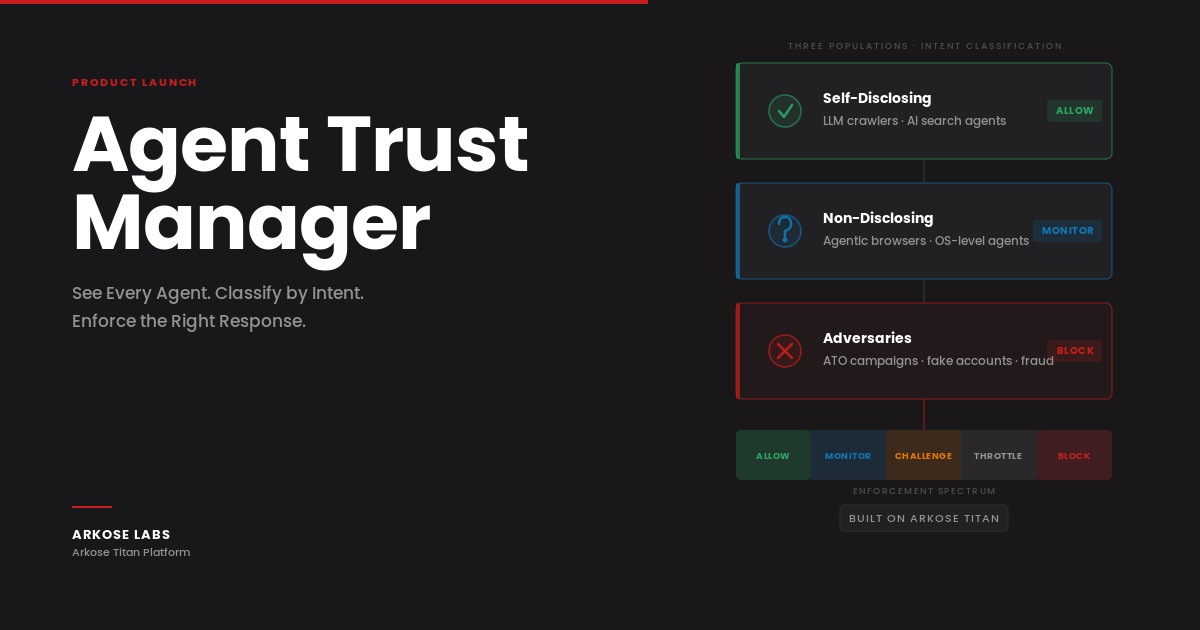
Arkose Labs built Agent Trust Manager on a decade of bot and challenge intelligence. Here is how it protects revenue and stops fraud losses in the era of AI agents.
18 June 2026
Shimon Modi
Arkose Product
Shimon Modi, SVP of Product at Arkose Labs, explains how Agent Trust Manager classifies three distinct agentic AI threat populations and enforces by intent.
17 June 2026
AI
Your customer's AI agent and a fraudster's use the same tools. See why AI agent detection now means classifying intent—not asking "bot or human?"
16 June 2026
Kevin Gosschalk
Arkose Titan
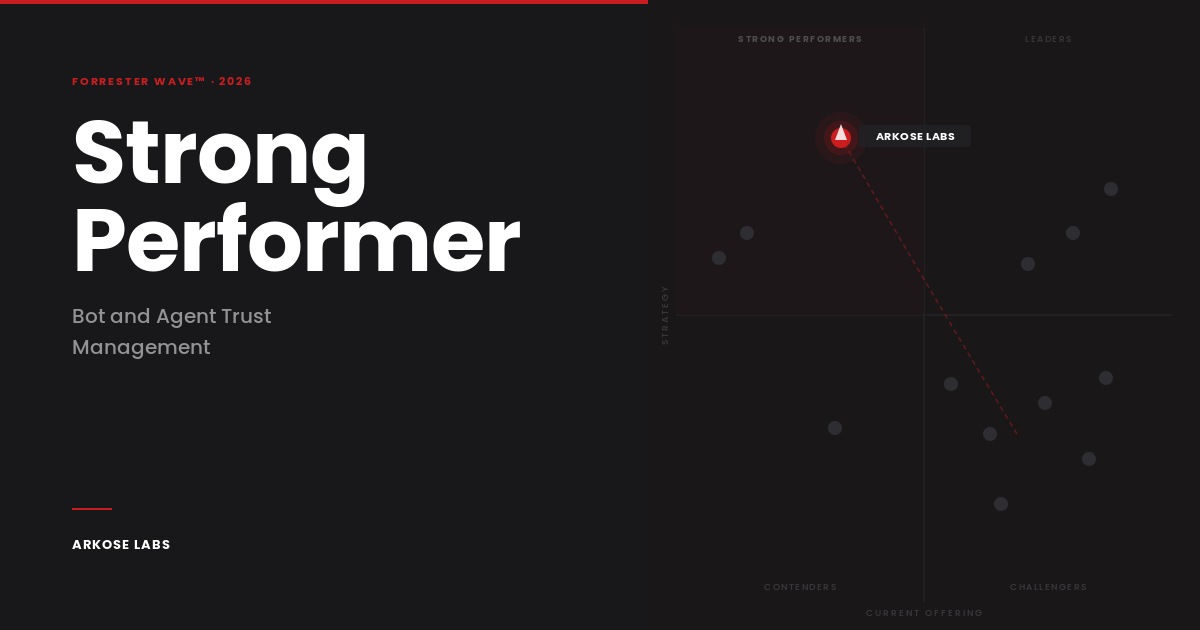
The Forrester Wave™ 2026 evaluates bot and agent trust management vendors. Learn why Arkose Labs earned a Strong Performer position and what it means for your security strategy.
15 June 2026
Agentic AI attackers don't just try to solve challenges, they reverse-engineer, intercept, and bypass them at machine speed. Most vendors' infrastructure wasn't built for this. Arkose Labs' was.
11 June 2026
Min Lin
In the age of AI accessibility agents, the audio challenge is no longer a compliance checkbox. It's a critical security surface.
9 June 2026
Gab Fitzgerald
Arkose MatchKey isn't a prettier CAPTCHA. It's a different mathematical and economic problem designed for AI.
3 June 2026
Whitney Constantine
Arkose Labs built MatchKey by studying how agentic AI attacks challenges at scale; see what AI-resistant challenge design means for fraud teams.
27 May 2026
Pass/fail challenge security discards your richest fraud signal. Treating the challenge as an intelligence sensor changes everything.
20 May 2026
Trust and safety leader Paul Rockwell on why the bot-vs-human binary is collapsing, and what security teams need to build before it does.
13 May 2026
Cassie Stevenson
Human Fraud Farms
SMS toll fraud isn't a payment fraud problem. It's a bot detection failure that human fraud farms exploit. Here's how it works.
12 May 2026
Leah Moore
Agentic AI has made fraud cheaper and faster than ever. Here's why the only durable response is making attacks cost more than they're worth.
11 May 2026
Economic deterrence makes human fraud farm operations unprofitable. Here's why detect-and-block can't change those economics - and what does.
5 May 2026
Agentic AI security architecture needs to be built around economics, not trust — and the data from RSAC 2026 shows why identity-first fails.
1 May 2026
Human fraud farms are built to defeat defenses like behavioral biometrics, IP reputation and challenge-response. Here's why each breaks down.
22 April 2026